




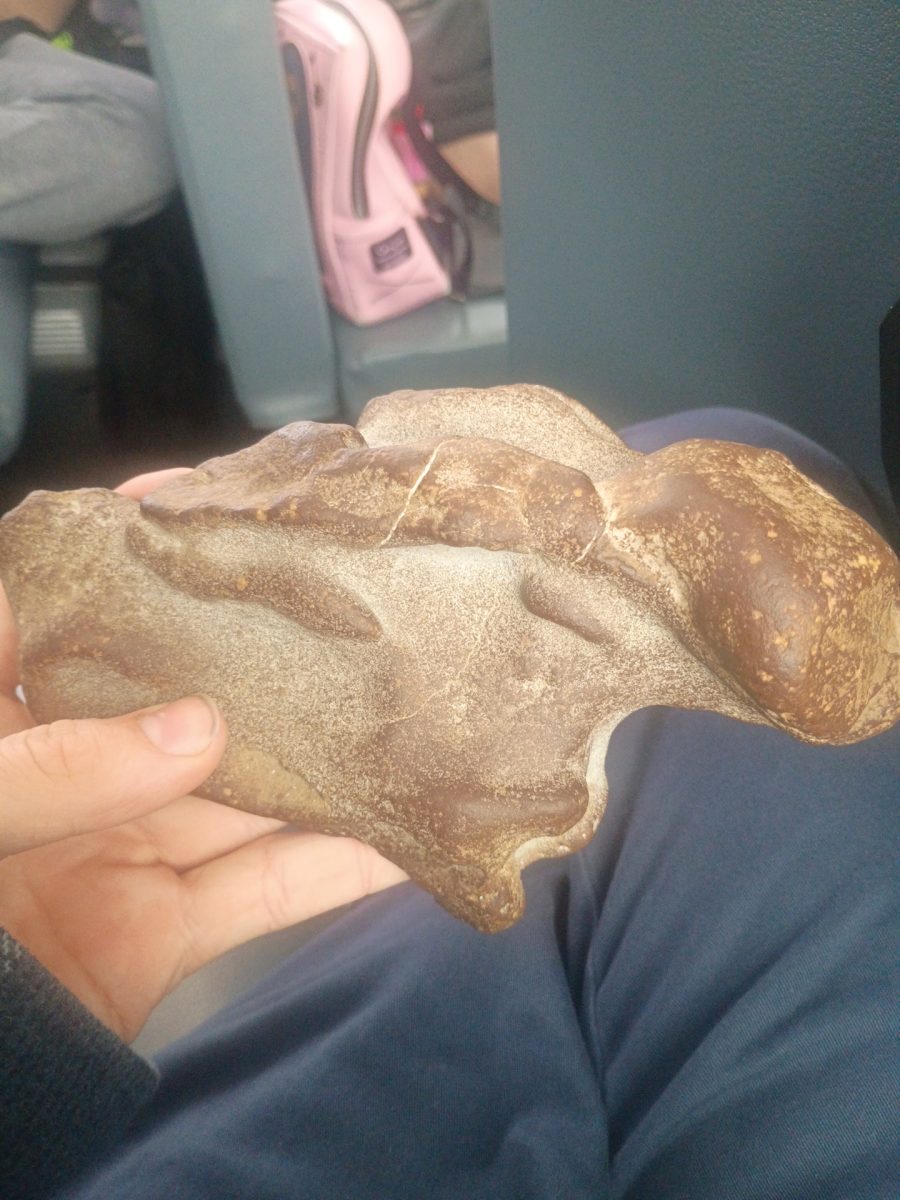



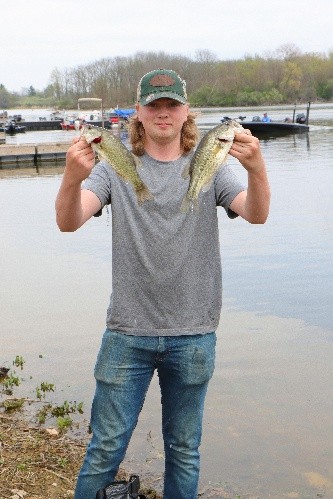










Junior Jesaun Auen was doing some exploring last week when he happened upon a curious object. “I was hiking with my mom by a creek in East Peoria. My mom saw something odd in the water,” Jesaun explained. Being a collector of unusual rocks, Jesaun waded into the creek to retrieve it. It looked like nothing he’d ever discovered.
It is brown, nobby on top, and flat on the bottom. It weighs about 2 lbs, and is 8 in. long, 4 in. wide, and 1 in. thick. Jesaun reported, “I had just gone on a family field trip to the Chicago Field Museum. The structure reminded me of some of the dinosaur fossils I had seen there.” He continued, “It had weird cracks in it that you don’t usually find in rocks.” His first guess, based on size and structure, was that it could be fossilized dino poop.
Actually, this may not be so far-fetched. Fossilized poop is known as coprolite. In Mazon Creek, Illinois, a coprolite was found that is believed to be from a shark 300 million years ago (which would predate the dinosaurs). Scientists analyze coprolite to learn more about what animals ate, the nature of their ecosystems, and parasite evolution. In fact, there is even human coprolite! The Lloyds Bank coprolite, found in England in 1972, is the largest human fossilized poop ever discovered. This 8-in. long, 2-in. wide log is believed to have come from a 9th-century Viking who ate a meat-heavy diet.
Jesuan believes it is more likely that the strange rock could be the pelvis or shoulder blade of an animal. He did show the artifact to EPG’s geology teacher, Mrs. Seeman, who was unsure of its composition. He thinks he may eventually show it to other experts to get their opinion. In the meantime, he plans to add it to his extensive rock collection, which includes obsidian, limestone, and rose quartz. The moral of the story is that it’s an amazing world out there, and you never know what you might find when you actually take the time to explore.